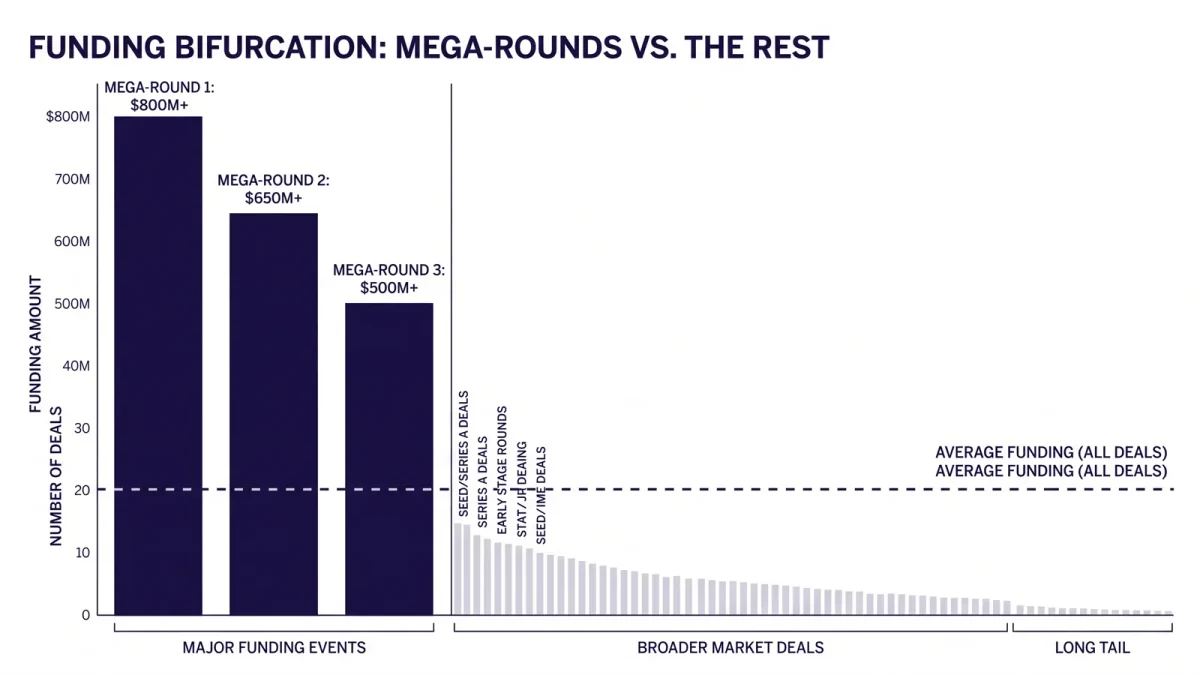
Global startup funding reached $189 billion in February 2026 — a monthly record, per Crunchbase News — but the number deserves a founder's careful read before it becomes a mood: roughly $171 billion, about 90% of the month's total, went to AI-related companies, and per Crunchbase's analysis about 83% of global funding flowed to just three companies — OpenAI, Anthropic, and Waymo. A record month for the record books was, for the other few thousand companies raising, an ordinary-to-good month inside a bifurcated market.
This is analysis of reported funding data, not investment advice or a market forecast.
What the record actually contains
Per Crunchbase News and deal trackers reporting on the month, February's largest rounds included Anthropic's $30 billion at a $380 billion valuation (announced February 12, per Reuters), Waymo at $16 billion, and OpenAI's $110 billion infrastructure raise with backing from Amazon, Nvidia, and SoftBank at $50B/$30B/$30B respectively, per Intellizence's deal summary. Wayve at $1.2 billion and World Labs at $1.0 billion rounded out the billion-dollar tier. Beneath the mega-rounds, the month was active but unremarkable: Series A trackers counted 47 rounds totaling about $1.45 billion — a healthy month, not a mania, and per TechCrunch's count 17 US-based AI companies had raised $100 million or more in 2026 to that point, three above $1 billion.
Related stories: First Half 2026 in Two Numbers: $506 Billion Raised, 105 IPOs · YC's Winter 2026 Batch: 196 Companies and What the Mix Tells Founders.
What the bifurcation means for founders raising
- Your comp set is not the headline: seed and Series A pricing is set by the funds that specialize there, whose activity looks like the Series A numbers above — solid, selective, and unmoved by mega-round math at the labs.
- AI positioning is now a filter, not a premium: with 90% of dollars flowing AI-ward, investors expect an AI thesis by default; the premium has moved to evidence — usage data, workflow depth, revenue — rather than the acronym.
- Talent and compute competition is the real spillover: the mega-funded companies bid up AI researchers and compute contracts, which lands on application-layer P&Ls as higher costs, whatever your funding tier.
The overlooked detail worth a founder's attention: the infrastructure concentration is a subsidy to everyone else. Every OpenAI and Anthropic dollar spent on compute and model capability cheapens the inputs that application companies build on — the market's extreme head is financing better foundations for its long tail.
What to do with this
If you're raising: price your round against your tier's reality, not the monthly record, and lead with the evidence filters investors now apply to AI claims. If you're building: the strategy that survives bifurcation is the boring one from any era — niche depth, proprietary data, capital efficiency — with the twist that your foundation-model inputs keep improving on someone else's capital. Records like February's make headlines and moods; the compounding companies are built on the quieter arithmetic underneath.